Wednesday, 5 June 2013

It is a Sin

Entertainment At Sin Bar

Well, Sin Bar has put on yet another evening of entertainment and food.
Mexican food was the order of the night, and looking at the plates, there was no doubt that it was enjoyed. The evening kicked off at 5 pm; there were people walking in and taxis rolling up to the door as the expat community came out to support the expat-run business. Kim has made big strides to open up the Sin Bar to become a place where you can come and take advantage of different activities.
Activities such as table tennis, art class, photography 101 class, a monthly garage sale, and foods of the world are some of the offerings.
A local promoter this evening is offering a sunset 2 hour cruise on a sail boat limited to 25 people for $35.00 on Friday, June 7th. Such a deal!
Apart from the food, part of the entertainment consisted of a solo artist playing the guitar with electronic backing, singing songs that most remember. Good to see that the crowd is not just a bunch of retirees!
More entertainment for the evening came from behind the bar. Claudia lit up Sin Bar not only with her looks but with a performance of fire dancing. As the lights went down in the bar and the music pulsed with excitement, the fire pots were lit and the dance began. Below you can see some of the act on video. Enjoy!  


This Month


June 6
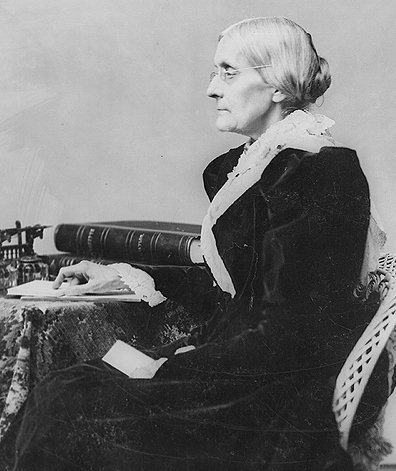
June 6, 1872 - Pioneering feminist Susan B. Anthony was fined for voting in a presidential election at Rochester, New York. After voting rights had been granted to African American males by the 15thAmendment, she attempted to extend the same rights to women. She led a group of women that voted illegally, to test their status as citizens. She was arrested, tried and sentenced to pay $100, which sherefused. Following her death in 1906 after five decades of tireless work, the Democratic and Republican parties both endorsed women's right to vote. In August of 1920, the 19th Amendment to the U.S. Constitution was finally ratified, allowing women to vote.
June 6, 1944 - D-Day, the largest amphibious landing in history, began in the early-morning hours as Allied forces landed in Normandy on the northern coast of France. Operation Overlord took months of planning and involved 1,527,000 soldiers in 47 Allied divisions along with 4,400 ships and landing craft, and 11,000 aircraft. The Germans had about 60 divisions spread along France and the Low Countries. American forces landed on two western beaches, Utah and Omaha, while British and Canadian troops landed farther east on Gold, Juno and Sword beaches. By the end of the day 150,000 Allied soldiers and their accompanying vehicles had landed with 15,000 killed and wounded.
June 6, 1978 - By a vote of almost two to one, California voters approved Proposition 13, an amendment to the state constitution severely limiting property tax rates.
Birthday - American patriot Nathan Hale (1755-1776) was born in Coventry, Connecticut. During theAmerican Revolution, he volunteered for a dangerous spy mission in Long Island and was captured by the British on the night of September 21, 1776. Brought before British General William Howe, Hale admitted he was an American officer. Howe ordered him to be hanged the following morning. As Hale mounted the gallows he uttered, "I only regret that I have but one life to lose for my country."
June 7
June 7, 1965 - The U.S. Supreme Court struck down a Connecticut law banning contraception. InGriswold v. Connecticut, the Supreme Court guaranteed the right to privacy, including freedom from government intrusion into matters of birth control.
Birthday - French painter Paul Gauguin (1848-1903) was born in Paris. He worked as a stockbroker, then became a painter in middle age. He left Paris and moved to Tahiti where he developed an interest in primitive art. Among his best known paintings; Vision After the Sermon (1888), When Shall We Be Married? (1892), Holiday (1896), and Two Tahitian Women (1899). His style using broad, flat tones and bold colors, inspired artists such as Edvard Munch, Henri Matisse, and the young Pablo Picasso.
June 8
June 8, 1874 - Apache leader Cochise died on the Chiricahua Reservation in southeastern Arizona. After a peace treaty had been broken by the U.S. Army in 1861, he waged war against settlers and soldiers, forcing them to withdraw from southern Arizona. In 1862, he became principal chief of the Apaches. He and 200 followers avoided capture by hiding in the Dragoon Mountains. In June of 1871, Army General George Crook assumed command in Arizona and managed to win the allegiance of many Apaches. Cochise then surrendered. He disappeared briefly in the spring of 1872, but returned and settled on the reservation where he died.
Birthday - American architect Frank Lloyd Wright (1867-1959) was born in Richland Center, Wisconsin. He designed about 1,000 structures and is considered the most influential architect of his time. He became the leader of a style known as the Prairie School featuring houses with low-pitched roofs and extended lines that blend into the landscape. He once wrote, "No house should ever be on any hill or on anything. It should be of the hill, belonging to it, so hill and house could live together each the happier for the other."
June 9
June 9, 1898 - The British signed a 99-year lease for Hong Kong, located on the southeastern coast of China. Hong Kong, consisting of an area measuring 400 square miles, was administered as a British Crown Colony until July 1, 1997, when its sovereignty reverted to the People's Republic of China.
Birthday - Composer and lyricist Cole Porter (1893-1964) was born in Peru, Indiana. He published his first song The Bobolink Waltz at the age of ten. His Broadway career was launched in 1928 when five of his songs were used in the musical play Let's Do It. Among his many contributions to the Broadway stage; Fifty Million Frenchmen, The Gay Divorcee, Anything Goes, Leave It to Me, Du Barry Was a Lady, Something for the Boys, Kiss Me Kate, Can Can and Silk Stockings.
June 10, 1652 - In Massachusetts, silversmith John Hull opened the first mint in America, in defiance of English colonial law. The first coin issued was the Pine Tree Shilling, designed by Hull.
June 10, 1942 - In one of the most infamous single acts of World War II in Europe, all 172 men and boys over age 16 in the Czech village of Lidice were shot by Nazis in reprisal for the assassination of SS leader Reinhard Heydrich. The women were deported to Ravensbrück concentration camp where most died. Ninety young children were sent to the concentration camp at Gneisenau, with some later taken to Nazi orphanages if they were German looking. The village was then completely leveled until not a trace remained.
Birthday - African American actress Hattie McDaniel (1889-1952) was born in Wichita, Kansas. She won an Academy Award in 1940 for her role as 'Mammy' in Gone with the Wind.
Birthday - Judy Garland (1922-1969) was born in Grand Rapids, Minnesota (as Frances Gumm). She is best remembered for her portrayal of Dorothy Gale in The Wizard of Oz (1939) and other films including Meet Me in St. Louis (1944) and Easter Parade (1948). She became one of the most popular concert performers of the 1950s and '60s and broke box-office records in New York City and London. She was found dead of an overdose of sleeping pills in London on June 22, 1969.
June 11
June 11, 1991 - Mount Pinatubo in the Philippines erupted, spewing ash into the air, visible over 60 miles. The surrounding areas were covered with ash and mud created by rainstorms. Nearby U.S. military bases were also damaged.
June 11, 1994 - After 49 years, the Soviet military occupation of East Germany ended. At one time there had been 337,800 Soviet troops stationed in Germany. Over 300,000 Russians died during World War II in the Battle for Berlin.
Birthday - German composer Georg Richard Strauss (1864-1949) was born in Munich. His best known works include; Till Eulenspiegel (1895), Also Sprach Zarathustra (1896) and Don Quixote (1898).
Birthday - American feminist and politician Jeannette Rankin (1880-1973) was born in Missoula, Montana. She was the first woman elected to the U.S. Congress. She was a reformer and a pacifist and was the only member of Congress to vote against a declaration of war against Japan following the attack on Pearl Harbor in December of 1941.
Birthday - Undersea explorer Jacques Cousteau (1910-1997) was born in Ste-Andre-de-Cubzac, France. In 1943, he helped invent the first underwater breathing apparatus, called the Aqualung. He is best known for his Emmy Award winning television series, The Undersea World of Jacques Cousteau,which premiered in the U.S. in 1968.
Birthday - American football coach Vince Lombardi (1913-1970) was born in Brooklyn, New York. In 1959, he became head coach of the Green Bay Packers, winning five NFL titles and two Super Bowls in nine seasons. He is generally regarded as the greatest coach and the finest motivator in football history. He retired in 1968, but was lured back to coach the Washington Redskins. He contracted cancer after coaching the Redskins for just one season and died September 3, 1970, in Washington, D.C.

Friday, 24 May 2013


The other Gringo Bar-
Gumbo Night Con Sin

This evening of Cajun food was well attended and all that I spoke with were enjoying themselves. There was a bit of a mix-up as to the start time, but it got sorted out and the gathering continued until the wee hours.
There was an unexpected visitor to Sin Bar, and that was the new addition to the household of Mike and Raquel - they have a young dalmatian.
The food was served in large bowls and quickly consumed; the drink made for the night was a hurricane - both of these went very well together. Thanks goes to Kathryn Van Horn Kelly and her husband Gary for the good eats and to Kim Griffiths for the hurricanes.
I took my camera and snapped  a few shots, so enjoy!


I received this in an email recently:

Ready for another Obnoxious Gringo (OG) story from Cuenca?  According to reports this week, an OG went into a local bank to change a $100 bill.  If you live here and pay attention, you know that only the Banco Central or a bank where you have an account will do that.  He did not  understand the clerk's explanation in that foreign language called Spanish, which angered him, so he began to berate the clerk, as OGs usually do when all they hear is Spanish.  A bilingual Ecuadorian approached him and explained in English why he needed to go to a different bank, and the OG verbally attacked him, too, using the "F" word as he told the helpful stranger to go perform a physically impossible act.  The Ecuadorian finally threatened to call the police, and the OG shut up and left.  Here's the part that should send a chilling message to every expat in Ecuador:  Everyone in the bank loudly applauded the man who got rid of the gringo.  Think about that reaction from normally quiet and non-confrontational Ecuadorians.

It is not getting better, folks.  Be part of the Behavior Modification Group and stop OGs in their tracks.  They will cuss at you because that's the only reaction those Lords of Arrogance know, but keep at it anyway.  Can you imagine the reaction of Ecuadorians if they saw another gringo -- instead of one of their own -- threaten an OG?  They do need to see that.  We need to show them.

Here's a good example of a proper reaction by an expat.  This morning I was checking out of the Supermaxi, and there was a gringo in the next line trying to buy several bottles of wine, not knowing it is not allowed on Sundays.  He listened patiently as the clerk and some folks in line tried to explain in Spanish why he could not buy the wine.  Did he do the OG thing and start calling the clerk names because she did not speak English?  No.  In fact, when I went over and explained it to him in English, he said, "Oh, I guess President Correa wants to keep us all healthy," and we both laughed. He was Canadian, by the way.


Gary Phillips is leaving Ecuador

GARY PHILLIPS

A View From the Roof


Gary Phillips has lived in Ecuador, I think, for the last 7 years and spent many years trying to set up a sustainable farm here, but the call of Ecuador was overtaken by the call of grandchildren.  So, he and his wife are moving to California to be close to the family. While here, they gave a good perspective of life in Ecuador, so the blog will be missed.


This Month

April 25, 1967 - The first law legalizing abortion was signed by Colorado Governor John Love, allowing abortions in cases in which a panel of three doctors unanimously agreed.
Birthday - Radio inventor Guglielmo Marconi (1874-1937) was born in Bologna, Italy. He pioneered the use of wireless telegraphy in the 1890's. By 1921, Marconi's invention had been developed into wireless telephony (voice radio).
April 26
April 26, 1937 - During the Spanish Civil War, the ancient town of Guernica was attacked by German warplanes. After destroying the town in a three hour bombing raid, the planes machine-gunned fleeing civilians.
April 26, 1944 - Federal troops seized the Chicago offices of Montgomery Ward and removed its chairman after his refusal to obey President Roosevelt's order to recognize a CIO union. The seizure ended when unions won an election to represent the company's workers.
April 26, 1986 - At the Chernobyl nuclear power plant in the Ukraine, an explosion caused a meltdown of the nuclear fuel and spread a radioactive cloud into the atmosphere, eventually covering most of Europe. A 300-square-mile area around the plant was evacuated. Thirty one persons were reported to have died while an additional thousand cases of cancer from radiation were expected. The plant was then encased in a solid concrete tomb to prevent the release of further radiation.
April 26, 1994 - Multiracial elections were held for the first time in the history of South Africa. With approximately 18 million blacks voting, Nelson Mandela was elected president and F.W. de Klerk vice president.
Birthday - American artist and naturalist John J. Audubon (1785-1851) was born in Haiti. He drew life-like illustrations of the birds of North America.
Birthday - Landscape architect Frederick Law Olmsted (1822-1903) was born in Hertfors, Connecticut. He helped design some of the most famous parks in America including Central Park in New York, the Emerald Necklace series of connecting parks in Boston, and Yosemite National Park.
Birthday - Nazi Rudolf Hess (1894-1987) was born in Alexandria, Egypt. He was Deputy Führer of Nazi Germany and a member of Hitler's inner circle. On May 10, 1941, he made a surprise solo flight and parachuted into Scotland intending to negotiate peace with the British. However, the British promptly arrested him and confined him for the duration. Following the war, he was taken to Nuremberg and put on trial with other top Nazis. He died in captivity in 1987, the last of the major Nuremberg war criminals.
April 27
April 27, 1865 - On the Mississippi River, the worst steamship disaster in U.S. history occurred as an explosion aboard the Sultana killed nearly 2,000 passengers, mostly Union solders who had been prisoners of war and were returning home.
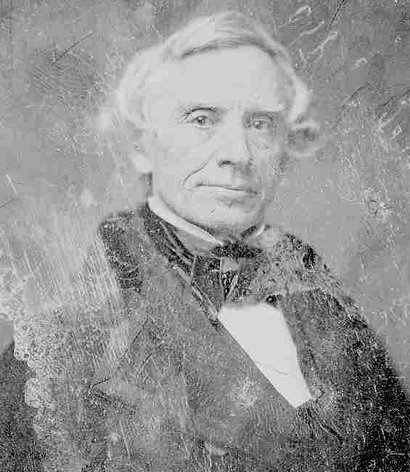
Birthday - Telegraph inventor Samuel F.B. Morse (1791-1872) was born in Charlestown, Massachusetts. He developed the idea of an electromagnetic telegraph in the 1830's and tapped out his first message "What hath God wrought?" in 1844 on the first telegraph line, running from Washington, D.C., to Baltimore. The construction of the first telegraph line was funded by Congress ($30,000) after Morse failed to get any other financial backing. After Western Union was founded in 1856, telegraph lines were quickly strung from coast to coast in America.
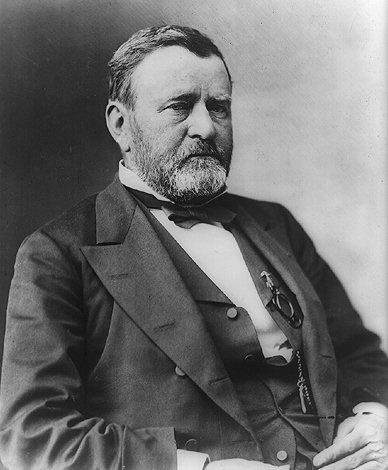
Birthday - Civil War General and 18th U.S. President Ulysses S. Grant (1822-1885) was born in Point Pleasant, Ohio. During the war, he earned the nickname "Unconditional Surrender" Grant and was given command of the Union armies. He served as President from 1869 to 1877 in an administration plagued by scandal. He then went on to write his memoirs and died in 1885, just days after its completion.
April 28
April 28, 1789 - On board the British ship Bounty, Fletcher Christian led a mutiny against Captain William Bligh, setting him and 18 loyal crew members adrift in a 23-foot open boat. Bligh survived a 47-day voyage sailing over 3,600 miles before landing on a small island. Christian sailed the Bounty back to Tahiti, eventually settling on Pitcairn Island and burning the ship.
April 28, 1945 - Twenty-three years of Fascist rule in Italy ended abruptly as Italian partisans shot former Dictator Benito Mussolini. Other leaders of the Fascist Party and friends of Mussolini were also killed along with his mistress, Clara Petacci. Their bodies were then hung upside down and pelted with stones by jeering crowds in Milan.
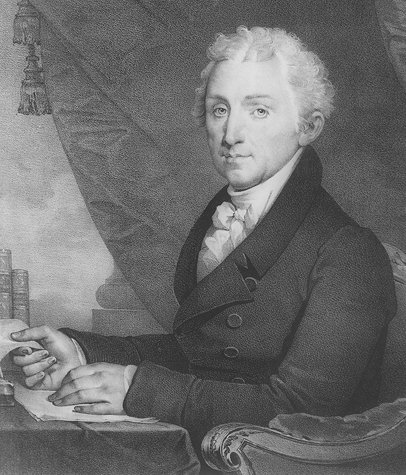
Birthday - James Monroe (1758-1831) the 5th U.S. President was born in Westmoreland County, Virginia. He served two terms from 1817 to 1825 and is best known for the Monroe Doctrine which declared the U.S. would not permit any European nation to extend its holdings or use armed force in North or South America.
April 29
April 29, 1992 - Riots erupted in Los Angeles following the announcement that a jury in Simi Valley, California, had failed to convict four Los Angeles police officers accused in the videotaped beating of an African American man.
Birthday - American publisher William Randolph Hearst (1863-1951) was born in San Francisco. The son of a gold miner, in 1887 he dropped out of Harvard to take control of the failing San Francisco Examiner which his father had purchased. He saved the Examiner, then went to New York and bought the New York Morning Journal to compete with Joseph Pulitzer. Hearst's sensational style of "yellow" journalism sold unprecedented numbers of newspapers and included promoting a war with Cuba in 1897-98. He expanded into other cities and into magazine publishing, books and films. He also served in Congress and nearly became mayor of New York City.
Birthday - Japan's Emperor Hirohito (1901-1989) was born in Tokyo. In 1926, he became the 124th in a long line of monarchs and then presided over wartime Japan which was led by militarist Prime Minister Hideki Tojo. Following the dropping of two atomic bombs by the U.S., he made a radio address urging his people to stop fighting. After the war, he remained the symbolic head of state in Japan's new parliamentary government. In 1946, he renounced his divinity and then pursued his interest in marine biology, becoming a recognized authority in the subject.
April 30
April 30, 1789 - George Washington became the first U.S. President as he was administered the oath of office on the balcony of Federal Hall at the corner of Wall and Broad Streets in New York City.
April 30, 1948 - Palestinian Jews declared their independence from British rule and established the new state of Israel. The country soon became a destination for tens of thousands of Nazi Holocaust survivors and a strong U.S. ally.
April 30, 1967 - Boxer Muhammad Ali was stripped of his world heavyweight boxing championship after refusing to be inducted into the American military. He had claimed religious exemption.


Wednesday, 8 May 2013

Winter is here

Cold here
               It went down to 25c or 78f`, which is not for ever one to be comfortable with, and you can see the locals walking around with overcoats, hats, and scarves.
For us this is just perfect, walking on the beach with a cool breeze and not having the AC running all day.
Just a couple of weeks ago, we heard a new sound coming from a speaker on a pickup truck. It took us a little while to understand what the message was. They were saying if you have a dog, we are giving free rabies injections. Our dogs are up to date, do not need it until 2015. We asked who was paying for this. We were told that it is a government program, and is an effort to control rabies. There is also a program in place to remove stray dogs.


Here is a link 
That you should click on or paste into your browser:


http://www.nbcnews.com/video/nightly-news/51768074/#51768074

http://www.nbcnews.com/video/nightly-news/51768074/#51737566

If this action is allowed to happen, then it will be a loss of a way of life and the pollution of a previously untouched bio diverse area of the world that will suffer from that loss. 


São Paulo
Before and after

The City That Said 'No' To Advertising


Less than a year ago this city passed a law that prohibited advertising- advertising on billboards, buses, walls,taxis- over 8000 billboards were removed, most of them were placed illegally.
The thinking behind this was, that you could not see the city for the ads, and that the ads did not add to the beauty of the city.
Can you imagine Salinas or La Libertad without ads?
This was a brave move on the part of that city, and only time will tell if it had merit.


Views of the Chocolatera


What, no water?

It is that time of year again, when for whatever reason, the water supply is switched off. Last year, it went off for two weeks. We will have to see how it goes this year, good job we have our EWS.


Sin Bar

This last Sunday, Sin Bar had a great turn out for the Cinco de Mayo celebration. They had live music, pulled pork, beans and potato salad that was very good. One thing noted by a number of people there was that the age of  attendees to functions like this is getting younger. It would seem that people are not waiting until they are in their sixties to retire. I think that is a good thing!


This Month


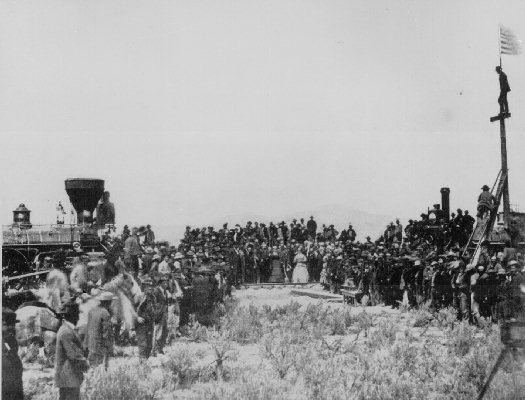
May 10, 1869 - The newly constructed tracks of the Union Pacific and Central Pacific railways were first linked at Promontory Point, Utah. A golden spike was driven by Leland Stanford, president of the Central Pacific, to celebrate the linkage. It is said that he missed the spike on his first swing which brought roars of laughter from men who had driven thousands upon thousands of spikes themselves.
May 10, 1889 - A riot erupted outside the Astor Place Opera House in New York as British actor William Charles Macready performed inside. Angry crowds revolted against dress requirements for admission and against Macready's public statements on the vulgarity of American life. The mob then shattered theater windows. Troops were called out and ordered to fire, killing 22 and wounding 26.
May 10, 1994 - Former political prisoner Nelson Mandela was inaugurated as president of South Africa. Mandela had won the first free election in South Africa despite attempts by various political foes to deter the outcome.
May 11
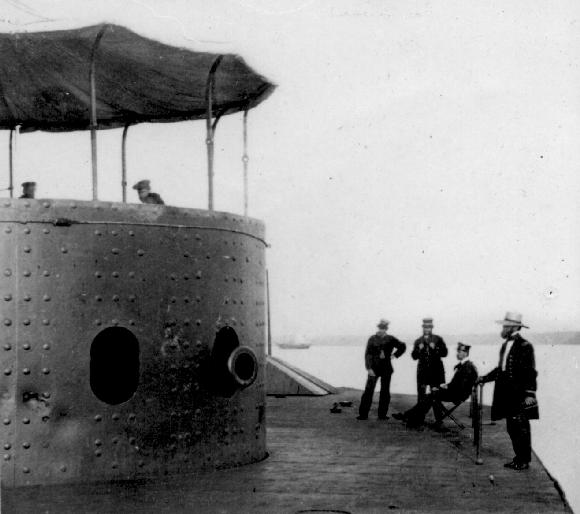
May 11, 1862 - To prevent its capture by Union forces advancing in Virginia, the Confederate Ironclad Merrimac was destroyed by the Confederate Navy. In March, the Merrimac had fought the Union Ironclad Monitor to a draw. Naval warfare was thus changed forever, making wooden ships obsolete.
May 11, 1969 - During the Vietnam War, the Battle of "Hamburger Hill" began. While attempting to seize the Dong Ap Bia Mountain, U.S. troops repeatedly scaled the hill over a 10-day period and engaged in bloody hand-to-hand combat with the North Vietnamese. After finally securing the objective, American military staff decided to abandon the position, which the North Vietnamese retook shortly thereafter. The battle highlighted the futility of the overall American military strategy.
Birthday - Songwriter Irving Berlin (1888-1989) was born (as Israel Isidore Baline) in Tyumen, Russia. At the age of four, Berlin moved with his family to New York City and later began singing in saloons and on street corners to help his family following the death of his father. Although he could not read or write musical notation, he became one of America's greatest songwriters, best known for songs such as God Bless America, White Christmas, There's No Business Like Show BusinessAlexander's Ragtime BandPuttin' On the Ritz, and Oh! How I Hate to Get Up in the Morning.
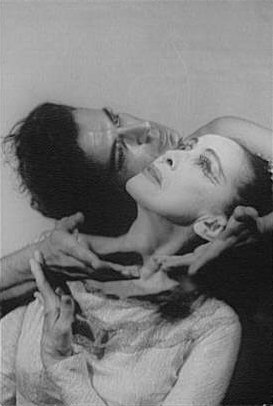
Birthday - Modern dance pioneer Martha Graham (1893-1991) was born in Pittsburgh, Pennsylvania. She began her dance career at age 22 in the Greenwich Village Follies. She later incorporated primal emotions and ancient rituals in her works, bringing a new psychological depth to modern dance. In a career spanning 70 years, she created 180 dance works. She performed until the age of 75.
May 12
May 12, 1937 - George VI was crowned at Westminster Abbey in London, following the abdication of his brother, Edward VIII. King George reigned until his death in 1952. He was succeeded by his daughter Elizabeth, the current reigning monarch.
May 12, 1949 - Soviet Russia lifted its blockade of Berlin. The blockade began on June 24, 1948 and resulted in the Berlin airlift. For 462 days - from June 26, 1948, until September 30, 1949, American and British planes flew about 278,000 flights, delivering 2.3 million tons of food, coal and medical supplies to two million isolated West Berliners. A plane landed in Berlin every minute from 11 Allied staging areas in West Germany. The planes were nicknamed ''candy bombers'' after pilots began tossing sweets to children. They also flew out millions of dollars worth of products manufactured in West Berlin.
Birthday - British nurse and public health activist Florence Nightingale (1820-1910) was born in Florence, Italy. She volunteered to aid British troops in Turkey where she improved hospital sanitary conditions and greatly reduced the death rate for wounded and sick soldiers. She received worldwide acclaim for her unselfish devotion to nursing, contributed to the development of modern nursing procedures, and emphasized the dignity of nursing as a profession for women.
May 13
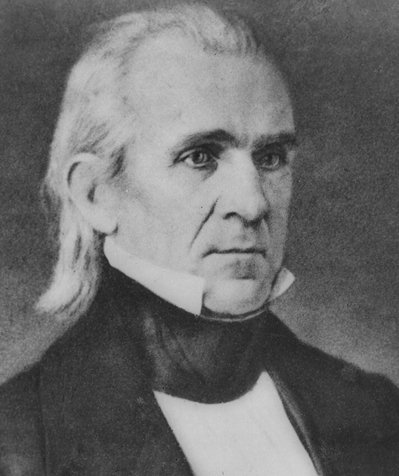
May 13, 1846 - At the request of President James K. Polk, Congress declared war on Mexico. The controversial struggle eventually cost the lives of 11,300 U.S. soldiers and resulted in the annexation of lands that became parts of Oklahoma, New Mexico, Arizona, Nevada, California, Utah and Colorado. The war ended in 1848 with the Treaty of Guadalupe Hidalgo.
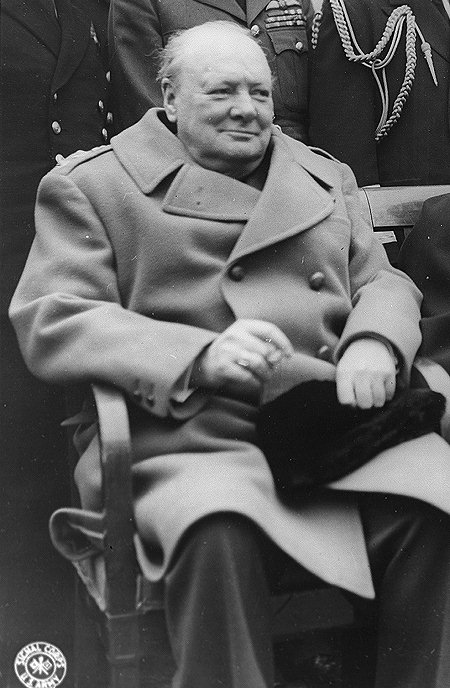
May 13, 1943 - During World War II in North Africa, over 250,000 Germans and Italians surrendered in the last few days of the Tunis campaign. British General Harold Alexander then telegraphed news of the victory to Winston Churchill, who was in Washington attending a war conference. The victory re-opened Allied shipping lanes in the Mediterranean.
May 13, 1981 - Pope John Paul II was shot twice at close range while riding in an open automobile in St. Peter's Square in Rome. Two other persons were also wounded. An escaped terrorist, already under sentence of death for the murder of a Turkish journalist, was immediately arrested and was later convicted of attempted murder. The Pope recovered and later held a private meeting with the would-be assassin and then publicly forgave him.
May 14
May 14, 1607 - The first permanent English settlement in America was established at Jamestown, Virginia, by a group of royally chartered Virginia Company settlers from Plymouth, England.
May 14, 1804 - Meriwether Lewis and William Clark departed St. Louis on their expedition to explore the Northwest. They arrived at the Pacific coast of Oregon in November of 1805 and returned to St. Louis in September of 1806, completing a journey of about 6,000 miles.
May 14, 1796 - Smallpox vaccine was developed by Dr. Edward Jenner, a physician in rural England. He coined the term vaccination for the new procedure of injecting a milder form of the disease into healthy persons resulting in immunity. Within 18 months, 12,000 persons in England had been vaccinated and the number of smallpox deaths dropped by two-thirds.
May 14, 1942 - During World War II, an Act of Congress allowed women to enlist for noncombat duties in the Women's Auxiliary Army Corps (WAAC), the Women Appointed for Voluntary Emergency Service (WAVES), Women's Auxiliary Ferrying Squadron (WAFS), and Semper Paratus Always Ready Service (SPARS), the Women's Reserve of the Marine Corp.
Birthday - German physicist Gabriel Fahrenheit (1686-1736) was born in Danzig, Germany. He introduced the use of mercury in thermometers and greatly improved their accuracy. His name is now attached to one of the major temperature measurement scales.
Birthday - British landscape and portrait painter Thomas Gainsborough (1727-1788) was born in Sudbury, Suffolk, England. Among his best known works: The Blue BoyThe Watering Place andThe Market Cart.
May 15, 1972 - George Wallace was shot while campaigning for the presidency in Laurel, Maryland. As a result, Wallace was permanently paralyzed from the waist down.
May 16
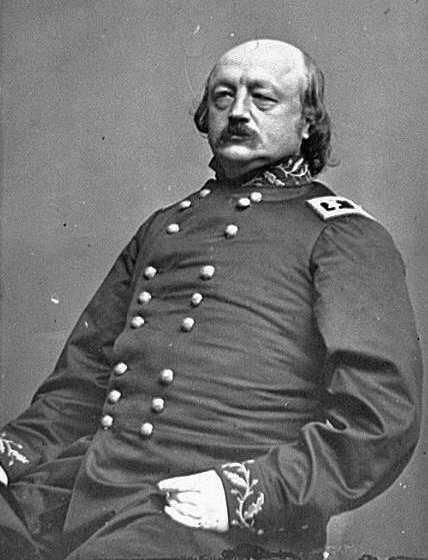
May 16, 1862 - During the American Civil War, Union General Benjamin Butler, military governor of New Orleans, issued his "Woman Order" declaring that any Southern woman showing disrespect for Union soldiers or the U.S. would be regarded as a woman of the town, or prostitute. This and other controversial acts by Butler set the stage for his dismissal as military governor in December 1862.

Tuesday, 23 April 2013

Change in the season


First, warning

The lady from South Africa is back. She will approach non-Ecuadorians with a sob story of being robbed, and is asking for help (money) as she has to sleep on the beach and is trying to get home.
This same lady was here last year, and depending on what you think the value of a donation to a fellow traveler is worth, she can make a very good living.


This is Earth Month

This is still earth month. What happens the rest of the year ?
Have you been able to consider what you can do for your environment?
Composting
Reusable shopping bags
Solar lighting
changing to LED lights
cooking with electricity
growing your own herbs
stop smoking
taking a bus
walking

The city of Salinas is putting out recycle bins, which is good; but, when they come to empty them, they are emptied into the same garbage truck as the trash(defeating the purpose).
Baby steps


Brunch
We recently went to a brunch gathering hosted by Randy and Jean, where they made an effort to conserve by using plates that were made from recycled material. The brunch was well attended and enjoyed; this was a nice effort on the part of recycling, and I hope the message was received by all who attended.


  GETTING WOMEN’S HEALTH SCREENINGS DONE LOCALLY

       We all want to stay as healthy as possible here in Ecuador.  Eating the fresh fruits and veggies that abound here as well as the unprocessed foods, those without any preservatives or artificial additives, definitely helps. Getting plenty of fresh air and moderate exercise and getting enough sleep are also excellent.  
        We women also are very interested in getting our screenings for cancer done on a regular basis. Two of these screenings are the pap smear and breast cancer screening.
         When I came to Ecuador, I asked a female friend whom I had come to know about a good GYN MD. She referred me to her GYN MD, whose office is in La Libertad, the next town to Salinas, a bus ride away.  So, I called the office and made an appointment, went in that Friday afternoon.  He asked me about my medical history, and I told him that all previous pap smears were negative for cancer.  He then did the pap smear and told me to come back in 2 weeks for the written results.  That visit cost me $10. I then asked him for an order for a mammogram for breast cancer screening, and he wrote it on a prescription pad.  I asked him where I could have it done, and he said SOLCA in Guayaquil.  Well, I asked my friend if there was any place closer to have this done, and she told me that there was a SOLCA in Santa Elena.  I found out that you can take the TRUNSA bus there for 25 cents.  
           So, Wednesday, I got there at 12noon, since I was told to come there at that time by the Director of SOLCA the day prior.  They only do echosonograms there, not mammograms, and only on Mondays, Wednesdays, and Fridays.  Since I have only had mammograms in the past that were negative for breast cancer, I believe that echosonograms are okay for me.
           Echosonograms of the breast use ultrasounds, in that the sound waves penetrate the tissues of the breast and the reflected sound is collected and formed into a picture.  The only preparation in having this test done is not to use any aluminum chlorhydrate in your underarm deodorant, or better yet, do not use any deodorant that same morning of the procedure.  After the procedure, you can use the deodorant.  They have you take your blouse and bra off, and give you a gown to put on.  Then the doctor uses a water-based gel on both breasts, and then uses a transducer, which looks like a microphone, and the gel makes it easier for the transducer to emit sound waves on the breast tissue, and the echoing sound waves produce a picture of the tissue on the computer, which then shows abnormalities, if there are any.  
            I researched the mammogram, which exposes the woman to radiation through Xrays of the breast to the echosonogram, which is a painless procedure and has no radiation exposure.   The mammogram alone and the echosonogram alone cannot detect all breast cancers, but both procedures done can detect most breast cancers.  However, thermography, which can detect breast abnormalities through heat detection of the breast tissue, is now considered in Europe and other countries, the safest and most accurate of all 3 procedures.  However, thermography is not used in the U.S.
            SOLCA in Santa Elena is a non-profit organization, which keeps the fees low to the public.  The echosonogram costs $15.  They also do many different lab tests there, as well as EKGs, and regular Xrays, but not mammograms.  They are, as far as I know, only done in Guayaquil.
             So, if you want an echosonogram done instead of the mammogram, have the GYN MD write the order for the echosonogram, because you need a written order to have it done.  If you want to go to SOLCA, just ask the bus driver to let you off there.  It is a block past the Automobile Club of Ecuador in Santa Elena.   I hope this has been helpful to you.


This Month


April 23rd - Established by Israel's Knesset as Holocaust Day in remembrance of the estimated six million Jews killed by Nazis.
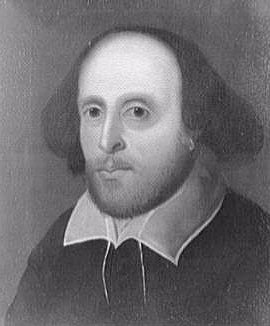
Birthday - William Shakespeare (1564-1616) was born at Stratford-on-Avon, England. Renowned as the most influential writer in the English language, he created 36 plays and 154 sonnets, includingRomeo and JulietHamlet and The Merchant of Venice.
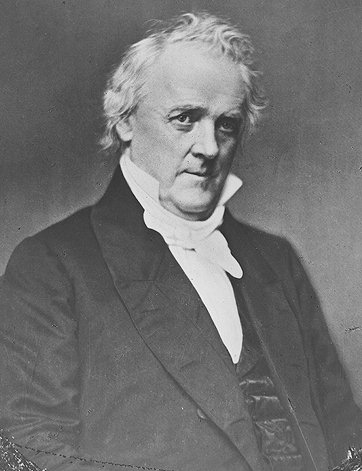
Birthday - James Buchanan (1791-1868) the 15th U.S. President was born in Cove Gap, Pennsylvania. He was the only life-long bachelor to occupy the White House, serving just one term from 1857 to 1861.
April 24
April 24, 1800 - The Library of Congress was established in Washington, D.C. It is America's oldest federal cultural institution and the world's largest library. Among the 145 million items in its collections are more than 33 million books, 3 million recordings, 12.5 million photographs, 5.3 million maps, 6 million pieces of sheet music and 63 million manuscripts. About 10,000 new items are added each day.
April 24, 1915 - In Asia Minor during World War I, the first modern-era genocide began with the deportation of Armenian leaders from Constantinople and subsequent massacre by Young Turks. In May, deportations of all Armenians and mass murder by Turks began, resulting in the complete elimination of the Armenians from the Ottoman Empire and all of the historic Armenian homelands. Estimates vary from 800,000 to over 2,000,000 Armenians murdered.
April 25, 1967 - The first law legalizing abortion was signed by Colorado Governor John Love, allowing abortions in cases in which a panel of three doctors unanimously agreed.
Birthday - Radio inventor Guglielmo Marconi (1874-1937) was born in Bologna, Italy. He pioneered the use of wireless telegraphy in the 1890's. By 1921, Marconi's invention had been developed into wireless telephony (voice radio).
April 26
April 26, 1937 - During the Spanish Civil War, the ancient town of Guernica was attacked by German warplanes. After destroying the town in a three hour bombing raid, the planes machine-gunned fleeing civilians.
April 26, 1944 - Federal troops seized the Chicago offices of Montgomery Ward and removed its chairman after his refusal to obey President Roosevelt's order to recognize a CIO union. The seizure ended when unions won an election to represent the company's workers.
April 26, 1986 - At the Chernobyl nuclear power plant in the Ukraine, an explosion caused a meltdown of the nuclear fuel and spread a radioactive cloud into the atmosphere, eventually covering most of Europe. A 300-square-mile area around the plant was evacuated. Thirty one persons were reported to have died while an additional thousand cases of cancer from radiation were expected. The plant was then encased in a solid concrete tomb to prevent the release of further radiation.
April 26, 1994 - Multiracial elections were held for the first time in the history of South Africa. With approximately 18 million blacks voting, Nelson Mandela was elected president and F.W. de Klerk vice president.
Birthday - American artist and naturalist John J. Audubon (1785-1851) was born in Haiti. He drew life-like illustrations of the birds of North America.
Birthday - Landscape architect Frederick Law Olmsted (1822-1903) was born in Hertfors, Connecticut. He helped design some of the most famous parks in America including Central Park in New York, the Emerald Necklace series of connecting parks in Boston, and Yosemite National Park.
Birthday - Nazi Rudolf Hess (1894-1987) was born in Alexandria, Egypt. He was Deputy Führer of Nazi Germany and a member of Hitler's inner circle. On May 10, 1941, he made a surprise solo flight and parachuted into Scotland intending to negotiate peace with the British. However, the British promptly arrested him and confined him for the duration. Following the war, he was taken to Nuremberg and put on trial with other top Nazis. He died in captivity in 1987, the last of the majorNuremberg war criminals.
April 27
April 27, 1865 - On the Mississippi River, the worst steamship disaster in U.S. history occurred as an explosion aboard the Sultana killed nearly 2,000 passengers, mostly Union solders who had been prisoners of war and were returning home.
Birthday - Telegraph inventor Samuel F.B. Morse (1791-1872) was born in Charlestown, Massachusetts. He developed the idea of an electromagnetic telegraph in the 1830's and tapped out his first message "What hath God wrought?" in 1844 on the first telegraph line, running from Washington, D.C., to Baltimore. The construction of the first telegraph line was funded by Congress ($30,000) after Morse failed to get any other financial backing. After Western Union was founded in 1856, telegraph lines were quickly strung from coast to coast in America.
Birthday - Civil War General and 18th U.S. President Ulysses S. Grant (1822-1885) was born in Point Pleasant, Ohio. During the war, he earned the nickname "Unconditional Surrender" Grant and was given command of the Union armies. He served as President from 1869 to 1877 in an administration plagued by scandal. He then went on to write his memoirs and died in 1885, just days after its completion.
April 28
April 28, 1789 - On board the British ship Bounty, Fletcher Christian led a mutiny against Captain William Bligh, setting him and 18 loyal crew members adrift in a 23-foot open boat. Bligh survived a 47-day voyage sailing over 3,600 miles before landing on a small island. Christian sailed theBounty back to Tahiti, eventually settling on Pitcairn Island and burning the ship.
April 28, 1945 - Twenty-three years of Fascist rule in Italy ended abruptly as Italian partisans shot former Dictator Benito Mussolini. Other leaders of the Fascist Party and friends of Mussolini were also killed along with his mistress, Clara Petacci. Their bodies were then hung upside down and pelted with stones by jeering crowds in Milan.
Birthday - James Monroe (1758-1831) the 5th U.S. President was born in Westmoreland County, Virginia. He served two terms from 1817 to 1825 and is best known for the Monroe Doctrine which declared the U.S. would not permit any European nation to extend its holdings or use armed force in North or South America.
April 29
April 29, 1992 - Riots erupted in Los Angeles following the announcement that a jury in Simi Valley, California, had failed to convict four Los Angeles police officers accused in the videotaped beating of an African American man.
Birthday - American publisher William Randolph Hearst (1863-1951) was born in San Francisco. The son of a gold miner, in 1887 he dropped out of Harvard to take control of the failing San Francisco Examiner which his father had purchased. He saved the Examiner, then went to New York and bought the New York Morning Journal to compete with Joseph Pulitzer. Hearst's sensational style of "yellow" journalism sold unprecedented numbers of newspapers and included promoting a war with Cuba in 1897-98. He expanded into other cities and into magazine publishing, books and films. He also served in Congress and nearly became mayor of New York City.
Birthday - Japan's Emperor Hirohito (1901-1989) was born in Tokyo. In 1926, he became the 124th in a long line of monarchs and then presided over wartime Japan which was led by militarist Prime Minister Hideki Tojo. Following the dropping of two atomic bombs by the U.S., he made a radio address urging his people to stop fighting. After the war, he remained the symbolic head of state in Japan's new parliamentary government. In 1946, he renounced his divinity and then pursued his interest in marine biology, becoming a recognized authority in the subject.
April 30
April 30, 1789 - George Washington became the first U.S. President as he was administered the oath of office on the balcony of Federal Hall at the corner of Wall and Broad Streets in New York City.
April 30, 1948 - Palestinian Jews declared their independence from British rule and established the new state of Israel. The country soon became a destination for tens of thousands of Nazi Holocaust survivors and a strong U.S. ally.
April 30, 1967 - Boxer Muhammad Ali was stripped of his world heavyweight boxing championship after refusing to be inducted into the American military. He had claimed religious exemption.